My phone died

The reason you give your kids a phone is so that they can reach you in an emergency, and so that you can reach them when you’re worried about them, which is most of the time. In the old days, before cell phones, when your teen went out, he was out until he got home, and you just dealt with it, because there was no choice. (Although there was that time my mom tracked me down at a friend of a friend of a friend’s house. But I digress.)
phonediescropToday, when your teen is out, you can check in on him periodically to reassure yourself that everything is okay. Until you can’t reach him. Then everything is not okay, even if it is.

So you keep calling because there is not much else you can do. And each time there is no answer, your concern grows, until you’ve imagined every possible ominous outcome. And when your teen walks through the door (safe and sound), you exhale, and then ask why he didn’t answer his phone, and you get some version of “my phone died.”

The battery life for the average, relatively new smartphone is about 8 ½ hours, when the phone is surfing on a 4G LTE network with at least three bars of service and the display is at 100 nits. A nit, a measurement of the brightness of light, is equal to one candela[1] per square meter (1cd/m2).  The sun at noon is rated at 1.6 billion nits, while a typical LCD panel has an output between 200 and 300 nits.[2],[3],[4]

With an 8 ½ hour charge and a variety of charging options everywhere, a dead battery seems highly unlikely and way to convenient, no? I thought so. So I Googled “my phone died” and got this entry in Urban Dictionary – When you’re on the phone and you really just want to get off, you say: “My phone is dying, gotta let you go.”

Nuff said.


[1] The candela, formerly called candlepower, is approximately the amount of light emitted by a common tallow candle. (I would argue that a tallow candle is not so common anymore.) Like horsepower, candlepower uses the technology that was in use at the time the new technology was introduced to measure the relative output of the new technology. Isn’t it time to update these measurements? We’re not measuring our boats in cubits anymore, are we? Any chance you’re going to drive 325 horses down to the supermarket? I say neigh.

[2] http://bestsmartphones2016.com/which-smartphone-has-the-best-battery-life-going-into-2016.html

[3] http://www.pcmag.com/encyclopedia/term/47996/nit

[4] http://whatis.techtarget.com/definition/nit

I’m sleeping at a friend’s house

sleepover2

“I’m sleeping at a friend’s house.” It’s the perfect cover story. And you never expect to get caught. How could you? Your parents aren’t that smart, and even if they are, it would take a little heavy lifting on their part to catch you.

Your motive is simple. You want to stay out all night and do whatever you want. But of course your parents would never agree to this. Enter the cover story. It goes something like this (of course there are many variations):

You tell your parents you’re sleeping at your friend’s house, and of course your friend tells his parents he’s sleeping at your house. To improve your chances for success, pick a friend whose parents live in a different neighborhood and travel in different social circles. What are the chances that they would talk and compare notes? You’re more likely to get struck by lightning, which according to the National Weather Service is about one chance in a million.

So in the scheme of things, you’re still feeling pretty good that your chances of getting caught if your parents meet somewhere are slim to none.

Enter slim.

What are the chances your mother would shop at another store in another neighborhood? Normally? 0%. Store coupon? 100%.

You see, your mom is a real bargain hunter, and she loves coupons, more so than most people. According to Inmar‘s 2014 Coupon Trends report, Americans were offered an average of $1,617 in coupons per person in 2013, but they only cashed in about $11.60, or less than 1%.  Not your mom.  She saves hundreds on coupons each year.  She’ll go to great lengths to use a coupon and save money. She’ll even bring her own frozen, uncooked turkey when she visits for Thanksgiving, from another city, clear across the country, even if it means stowing it in the overhead compartment in a bowling ball bag. Why? She had a coupon of course.  This was back when they still let turkeys fly coach.

As a little kid, you were probably getting roped into questionable coupon capers against your will. A typical scenario familiar to coupon captive kids involved getting around the LIMIT 1 PER HOUSEHOLD restriction common on many coupons.  Any coupon with the word “LIMIT” on it is just a challenge for money-saving moms.  She checks out with her shopping cart full of groceries, which includes, for example, a 50-cent-off can of coffee. And you would be right behind her with your single can of coffee (decaf, of course, cause what kid drinks regular coffee?) to take advantage of the second coupon.

Didn’t anyone ever wonder how you got there and why you were just buying just one item? Didn’t they see your mom giving you the money to pay for the item?  What kind of household were you running anyway?

With her store coupons in hand, in a grocery far, far away, what are the chances your mother would run into your friend’s mother and thank her for having you sleep over? Guess. And what are the chances you get grounded? 100%.

You don’t mess around with slim.

It WAS an emergency

Definitions matter. What a parent considers an emergency and what a kid considers an emergency hardly belong in the same category, especially when a credit card is involved.

breakglassAccording to the FCC (Federal Communications Commission), an emergency is a life-threatening situation where every second counts, such as a heart attack, uncontrolled asthma attack, child birth in progress, any event involving large amounts of blood, uncontrolled fire, a life-threatening event such as a knife fight, an armed robbery in progress, or a serious car accident.

When you think of emergencies, you think of dialing 9-1-1. An estimated 240 million 9-1-1 calls are made in the U.S. each year.  The first-ever 911 call in the United States happened on February 16, 1968, in Haleyville, Alabama, according to the Haleyville Chamber of Commerce.  Known as the “The City Where 911 Began,” Haleyville, Alabama, holds a 911 festival every year that honors all police, fire, and emergency personnel.  The phone used to answer the first 911 call is actually in a museum in Haleyville, which is half-way between Bear Creek and Delmar, about an hour and a half northwest of Birmingham, in case you’re planning a visit.

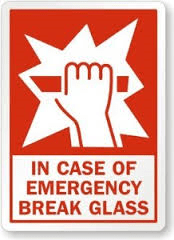
Being the concerned parent that you are, you give your teen a credit card with instructions to “break glass in case of emergency.” In fact, you even put that image on the outside of the envelope when you give him the card.

Then you get the urgent call or text message asking if it’s okay to use the credit card. You stress over the possible emergency scenarios prompting the request:

  • The car breaks down in the middle of the night in the middle of nowhere (of course there’s not many places to use the credit card in the middle of nowhere, except perhaps the Bates Motel).
  • His luggage got lost in transit and he has no clothes.
  • He had to buy textbooks today because there’s already reading due for tomorrow (giving him the benefit of the doubt on this one because thousands in tuition are at stake, and hey, the boy wants to study).

Your kid (safe and sound, I might add) is busy spinning his predicament – a personal crisis at best – into something remotely resembling an emergency.

  • The sushi was more expensive that I thought.
  • My friend forgot his wallet.
  • I needed to take a cab cause I missed the last bus.
  • I lost my hoodie, again.

As you exhale, thankful that it’s not an emergency of the FCC, or Haleyville, variety, you try to figure out where things went wrong. Was the call a mistake? It’s possible. Nearly 4 out of every 10 calls placed to 911 operators in New York City in 2010 were made inadvertently; most were “butt dials” – accidental calls that occur when a phone is in someone’s back pocket. That amounted to around 3.9 million butt dials in 2010, or about 10,700 per day. With a name like Aaron, the only entry before mine in most people’s alphabetized phone contact list is Aardvark, and they’re not going to be much help in an emergency, unless you’re under attack from ants.

The show’s almost over

How long is an hour TV show? It sounds like a corny joke, like, Who’s buried in Grant’s tomb? or How many gallons does a 10-gallon hat hold? or How many years did the Hundred Years’ War last? (It actually lasted 116 years.)

So how long is an hour TV show? One hour, right? Not so fast. According to a 2014 study from the ratings measurement firm Nielsen[1], the average 1-hour TV show has only 45 minutes and 45 seconds of content, plus 14 minutes and 15 seconds of commercials. Commercial time increased by 6% in the five years covered by the Nielsen study, so the amount of watchable content is actually shrinking. That’s broadcast TV.  For cable networks, the average commercial time was almost 10% higher, clocking in at a greedy 15 minutes and 38 seconds. Some cable companies are even speeding up their shows by using compression technology so they can cram even more commercials into an hour[2].

Even with all of the commercials, it still takes an hour to watch the show, right? Not if you watch the show on Netflix or Amazon, where there are no commercials. If they skip the intro and closing credits, your kids should be able to get through an average episode of whatever mind-numbing, brain-melting show they’re watching in about 40 minutes with one of these online services.

Now picture this familiar scene: Your kid (usually 10 and under) is watching a show or video.

You: “It’s time for (fill in the blank – bed/bath/beyond)”

Kid: “Can I just watch the end of this show/video?”

You: “How much time is left?”

Kid: “It’s almost over.”

“Almost” is a relative word. The recession is “almost over” too, except for all those people who are unemployed or underemployed.  The wait for Mad Men to resume its final season was “almost over,” but no one knew for sure.  That Grateful Dead guitar solo is “almost over” too.  The war in (insert middle-eastern country) is almost over as well, except it’s not and will most likely never be. You get the picture.

You’re ready for this one, though. Knowing that the typical one-hour Netflix show is no more than 40 minutes long, and that the law of averages would indicate that on any given day you’re going to walk in when the show is half over, almost over probably means 5-10 minutes to you, right? Maybe 15 minutes at the most. Because you’re good at math. You took calculus and statistics…multiple times.

But by the time you realize that the show/video just started and is not even close to being over, you’ve already agreed to let your kid watch until it’s over, at which point you’ve given up and gone to sleep, because your day is actually over.

[1] TV networks load up on commercials, http://www.latimes.com/entertainment/envelope/cotown/la-et-ct-nielsen-advertising-study-20140510-story.html

[2] Cable networks are speeding up TV shows to cram in ads, http://www.cbsnews.com/news/cable-networks-are-speeding-up-tv-shows-to-cram-in-ads/