Definitions matter. What a parent considers an emergency and what a kid considers an emergency hardly belong in the same category, especially when a credit card is involved.
 According to the FCC (Federal Communications Commission), an emergency is a life-threatening situation where every second counts, such as a heart attack, uncontrolled asthma attack, child birth in progress, any event involving large amounts of blood, uncontrolled fire, a life-threatening event such as a knife fight, an armed robbery in progress, or a serious car accident.
When you think of emergencies, you think of dialing 9-1-1. An estimated 240 million 9-1-1 calls are made in the U.S. each year. The first-ever 911 call in the United States happened on February 16, 1968, in Haleyville, Alabama, according to the Haleyville Chamber of Commerce. Known as the “The City Where 911 Began,” Haleyville, Alabama, holds a 911 festival every year that honors all police, fire, and emergency personnel. The phone used to answer the first 911 call is actually in a museum in Haleyville, which is half-way between Bear Creek and Delmar, about an hour and a half northwest of Birmingham, in case you’re planning a visit.
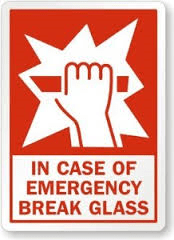
Being the concerned parent that you are, you give your teen a credit card with instructions to “break glass in case of emergency.” In fact, you even put that image on the outside of the envelope when you give him the card.
Then you get the urgent call or text message asking if it’s okay to use the credit card. You stress over the possible emergency scenarios prompting the request:
- The car breaks down in the middle of the night in the middle of nowhere (of course there’s not many places to use the credit card in the middle of nowhere, except perhaps the Bates Motel).
- His luggage got lost in transit and he has no clothes.
- He had to buy textbooks today because there’s already reading due for tomorrow (giving him the benefit of the doubt on this one because thousands in tuition are at stake, and hey, the boy wants to study).
Your kid (safe and sound, I might add) is busy spinning his predicament – a personal crisis at best – into something remotely resembling an emergency.
- The sushi was more expensive that I thought.
- My friend forgot his wallet.
- I needed to take a cab cause I missed the last bus.
- I lost my hoodie, again.
As you exhale, thankful that it’s not an emergency of the FCC, or Haleyville, variety, you try to figure out where things went wrong. Was the call a mistake? It’s possible. Nearly 4 out of every 10 calls placed to 911 operators in New York City in 2010 were made inadvertently; most were “butt dials” – accidental calls that occur when a phone is in someone’s back pocket. That amounted to around 3.9 million butt dials in 2010, or about 10,700 per day. With a name like Aaron, the only entry before mine in most people’s alphabetized phone contact list is Aardvark, and they’re not going to be much help in an emergency, unless you’re under attack from ants.
 Lies Kids Tell Their Parents